Our quality features at a glance

We guarantee our customers the utmost care in sourcing raw materials throughout the entire supply chain and at all processing stages. We work strictly and consistently in accordance with EU food law. The safety and quality of our raw material products are our top priority!

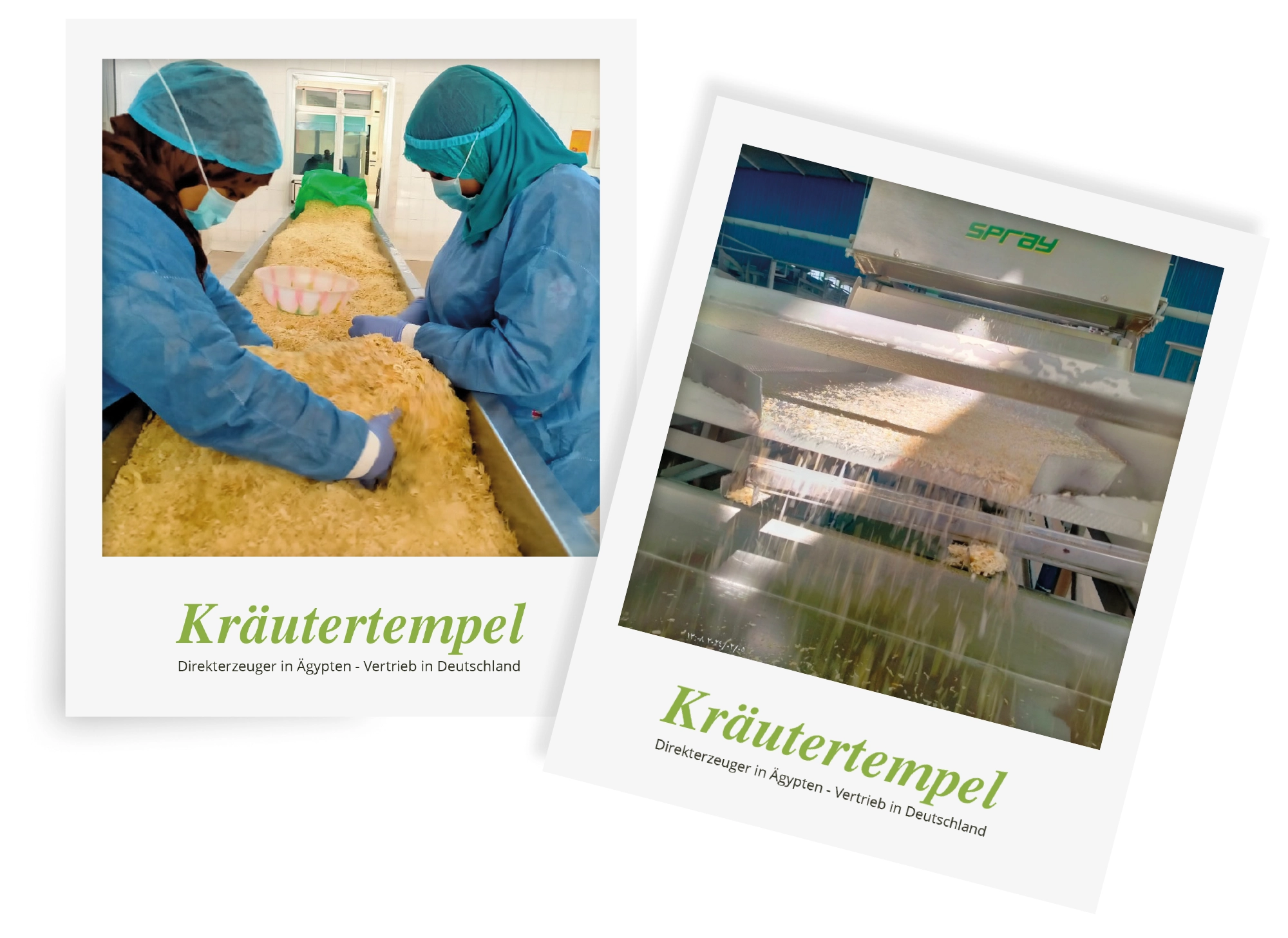
We have known our partner farms & businesses in Egypt for more than 20 years, and we visit and audit them several times a year. Kräutertempel is a member of the Fachverband der Gewürzindustrie e.V. (German Spice Industry Association), Bonn, and benefits from the association’s knowledge and expertise in the processing of spices and herbs.

Our main suppliers in Egypt

Certificate pursuant to Article 35(1) of Regulation (EU) 2018/848 on organic production  CERES (EG-BIO-140) & in addition to the above-mentioned certifications of Kräutertempel also: FSSC 22000 (globally recognised management system, “GFSI standard”) and SMETA (SEDEX).

We also source a small number of products from other origins, e.g. India, and the quality standards mentioned above apply here as well.

Kräutertempel GmbH
Certificate pursuant to Article 35(1) of Regulation (EU) 2018/848 on organic production  / ABCERT AG control body  (DE-ÖKO-006), Martinstraße 42-44 , 73728, Esslingen am Neckar

ISO  9001:2015 – (quality management)
ISO 22000:2018 – (food safety)
ISO 22301:2019 – (business continuity management systems (BCMS))
ISO 26000:2010- (social responsibility & establishing sustainability)
ISO 14001:2015 – (environmental management and sustainability goals)
ISO 45001:2018 – (occupational health and safety)
GMP – (good manufacturing practice)
HALAL

We take this responsibility very seriously and therefore have our imported raw materials extensively tested batch by batch by independent accredited laboratories in Germany (GBA, Bilacon, Eurofins or others):
e.g. for pesticides – microbiology – heavy metals – chemical-physical parameters – PAHs (polycyclic aromatic hydrocarbons) – PAs (pyrrolizidine alkaloids), chlorate/perchlorate and other, often product-specific parameters or the specific requirements of our customers. Once they arrive in Germany, incoming goods undergo strict sensory checks in our organic-certified warehouse. Samples are taken in accordance with DIN EN ISO 948 or separately in accordance with Regulation (EU) 2023/2783 by our trained, long-serving staff.
Deliveries to our customers are only made after analytical and sensory testing and release.

We oblige our suppliers and their business partners to comply with a code of conduct. In addition, our main supplier (El Malek Co.)  has been a member of Sedex, a platform for increasing transparency in the supply chain, for many years. DIN EN ISO 26000:2010 serves as the basis for understanding and establishing sustainability. Both Kräutertempel and our supplier in Egypt hold the corresponding certification.

The ISO 9001:2015 standard is the world’s best-known standard for quality management systems (QMS). It specifies how companies organise their internal processes so that products and services consistently deliver high quality. The standard applies across all industries – from small businesses to large corporations, from industry to the service sector. Its core principle is a risk-based approach: companies must systematically identify and manage risks and opportunities. The so-called PDCA cycle (Plan – Do – Check – Act) ensures continuous improvement. The standard follows the Harmonised Structure (HLS), which makes it easier to combine with other ISO standards – e.g. ISO 14001 for environmental management or ISO 22000 for food safety. Certification is voluntary, but many clients and trading partners require it as a minimum.

The ISO 22000:2018 standard is an international standard for food safety management systems (FSMS). It specifies how companies along the entire food chain – from producer to consumer – must systematically identify, assess and control hazards. The standard applies to all organisations, regardless of size or sector: farmers, manufacturers, traders, transport companies and more. It is based on the HACCP principles (hazard analysis and critical control points) and a risk-based approach. The 2018 version follows the ISO High Level Structure, which makes it easier to combine with other standards such as ISO 9001. Certification is voluntary but recognised worldwide and opens doors to new markets.

The ISO 22301:2019 standard is the international standard for business continuity management systems (BCMS). Put simply, it helps companies remain operational even in the event of serious disruptions such as natural disasters, IT failures or crises. The standard specifies how organisations prepare preventively, respond to disruptions and restore operations as quickly as possible. It applies to companies of any size and sector. Core elements are risk analysis, business impact analysis (BIA) and specific emergency and recovery plans. The 2019 version also follows the ISO High Level Structure, which makes it easier to combine with other standards such as ISO 9001 or ISO 27001. Certification is voluntary but sends a strong signal to customers and partners that the company is crisis-resilient.

The ISO 26000:2010 standard is the international guidance on social responsibility of organisations – also known as Corporate Social Responsibility (CSR). It provides companies, public authorities and NGOs with guidance on how to act responsibly towards society and the environment. Unlike ISO 9001 or ISO 22000, it is not certifiable – it is a voluntary guidance framework, not a management system. The standard is based on seven principles: accountability, transparency, ethical behaviour, respect for stakeholder interests, respect for the rule of law, respect for international norms of behaviour and respect for human rights. It covers seven core subjects: organisational governance, human rights, labour practices, the environment, fair operating practices, consumer issues and community involvement. The standard was developed with the participation of experts from more than 90 countries and 40 international organisations.

The ISO 14001:2015 standard is the world’s leading standard for environmental management systems (EMS). It sets out how companies can systematically record, manage and continuously reduce their environmental impact. The standard applies to organisations of any size and sector – from industry to the service sector. Its core principle is the PDCA cycle (Plan–Do–Check–Act) for continuous improvement of environmental performance. The 2015 version places greater emphasis on the life cycle perspective: environmental impacts are considered from product development to disposal. In addition, top management is more closely involved, and environmental management is understood as an integral part of corporate strategy. Like ISO 9001, it follows the High Level Structure, which allows easy integration with other standards. Certification is voluntary but internationally recognised and is regarded as proof of credible environmental commitment.

The ISO 45001:2018 standard is the first international standard for occupational health and safety management systems (OHSMS) – i.e. for safety and health at work. In March 2018 it replaced the previous standard OHSAS 18001. The aim is to systematically prevent occupational accidents, injuries and work-related illnesses – through prevention rather than reaction. The standard applies to organisations of any size and sector. A central focus is on the active participation of employees and the greater responsibility of top management for occupational safety. Companies must identify hazards, assess risks and implement specific protective measures. Like ISO 9001 and ISO 14001, it follows the High Level Structure, which makes integration with other standards easier. Certification is voluntary but strengthens the corporate image and demonstrates reliable risk management to customers and authorities.

An international certification scheme specifically for the feed industry. Its aim is to ensure the safety and quality of animal feed along the entire supply chain. The “+” stands for the integration of the HACCP principles – i.e. active risk analysis and control in addition to good manufacturing practice. It consists of two modules: GMP+ FSA (feed safety assurance) and GMP+ FRA (feed responsibility assurance). It applies to all links in the feed chain: manufacturers, traders, transporters and storage operators. Safely fed animals ultimately also mean safe food for people.

The HALAL certificate confirms that a product has been manufactured in accordance with Islamic dietary and purity laws. It applies not only to food but also to cosmetics, medicines and other products. The entire production chain is inspected: raw materials, processing, storage, cleaning and hygiene. An accredited certification body carries out an on-site audit and issues the certificate if the requirements are met. The certificate is particularly important for access to international markets with a large Muslim population – in some countries, such as the UAE, it is even mandatory for food imports. There are more than 1.8 billion Muslims worldwide, which makes HALAL one of the most important food standards in the world.


Our testing partners

The GBA Group is an internationally leading life science service company headquartered in Hamburg, specialising in laboratory analysis, consulting and logistics. It provides services for industries such as pharmaceuticals, medical devices, food, environment and cosmetics to ensure safety and compliance.